

What All This Rain Is Really Doing to Your Home's Exterior
If it feels like Edmonton has traded its usual summer for a monsoon, you're not imagining it. This has officially become the rainiest summer on record for the city, with storm after storm rolling through, from flooded roadways and downed trees to a severe thunderstorm that shut down Whitemud Drive and trapped vehicles under the 170 Street overpass in late July. Back-to-back downpours have already flooded roadways and caused power outages across the city this month.
All that water isn't just a mild inconvenience to our summer plans; it's quietly ruining the outside of your house, too! We have put together a quick list of what a summer of relentless rain can mean for your home's exterior, and what's worth keeping an eye on.
1. Foundation & Grading
Your foundation is designed to handle some water. What it's not designed for is week after week of saturated soil pressing against it.
When the ground around your home stays soaked, hydrostatic pressure builds up against your foundation walls, which can lead to:
- Water seeping through basement walls or the floor-wall joint
- Cracks that widen over repeated wet/dry cycles
- Efflorescence (that chalky white residue) showing up on basement walls
The grading around your home matters more than most people realize. If the soil slopes toward your house instead of away from it, every storm is sending water exactly where you don't want it.
2. Eavestroughs & Downspouts
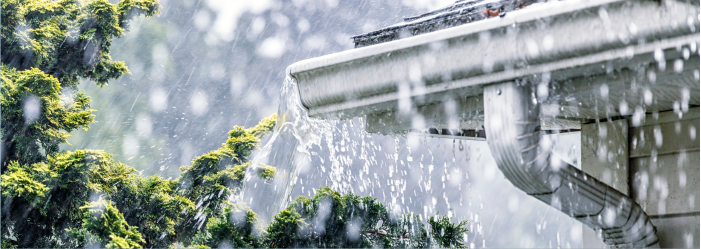
Your gutters are the first line of defence — and this summer, they've been working overtime. Clogged or undersized eavestroughs can't move water away fast enough, which means it spills over the sides and pools right at your foundation, the one place you least want it.
Worth checking after a summer like this:
- Downspouts extending at least 5–6 feet away from the foundation
- No sagging or pulling-away sections in the eavestrough itself
- No overflow staining on siding below the gutter line
3. Siding & Exterior Walls
Prolonged moisture exposure is tough on siding, especially at the seams, corners, and anywhere caulking has started to fail. Wood siding is particularly vulnerable to rot when it can't dry out between storms, but vinyl and even stucco aren't immune — water finds its way behind the surface through the smallest gaps and causes damage you won't see until it's already progressed.
4. Roofing
Repeated heavy rain is a stress test for your roof. Shingles that were already aging can lift, curl, or lose granules faster under constant wet-dry cycling, and any small gaps around flashing, vents, or chimneys become much bigger problems when there's this much water looking for a way in. A slow roof leak can go unnoticed for months, quietly damaging attic insulation and framing the whole time.
5. Windows & Doors
Seals and caulking around windows and exterior doors take a beating during a rainy stretch like this one. Once a seal fails, water can track behind trim and into wall cavities — often showing up later as a mystery stain nowhere near where the actual leak is happening.
6. Landscaping & Window Wells
Erosion happens fast when storms keep coming one after another. Mulch and topsoil wash away, exposing plant roots and sometimes shifting the grade near your foundation. Window wells are especially worth a look after storms like the ones we've had this month — if drainage at the bottom of the well is blocked, it can turn into a mini reservoir right against your basement window.
Signs You Shouldn't Ignore
- A musty smell in the basement that wasn't there before
- New or growing cracks in the foundation
- Peeling paint or bubbling on interior walls near the exterior
- Soft or spongy spots on siding or exterior trim
- Water stains on the ceiling or upper walls
Any one of these on its own might be nothing. A few of them together, especially after a summer this wet, are worth getting checked out before winter freeze-thaw cycles make things worse.
When It's Worth Calling In a Professional
A lot of rain damage doesn't announce itself right away — it shows up gradually, in places you're not checking on a regular basis. Our inspectors use thermal imaging and moisture testing on every inspection, which means we can spot elevated moisture levels in walls and framing long before they turn into a visible (and expensive) problem.
If this summer's storms have you wondering what's really going on behind your siding, under your shingles, or around your foundation, we're happy to take a look.
Contact Emerald Property Inspections today for a quote. 📞 780-850-7094 | ✉️ support@emeraldinspections.ca
Serving Edmonton, St. Albert, Sherwood Park, Spruce Grove, Fort Saskatchewan, Leduc & area.